NITZER EBB: LET YOUR BODY LEARN
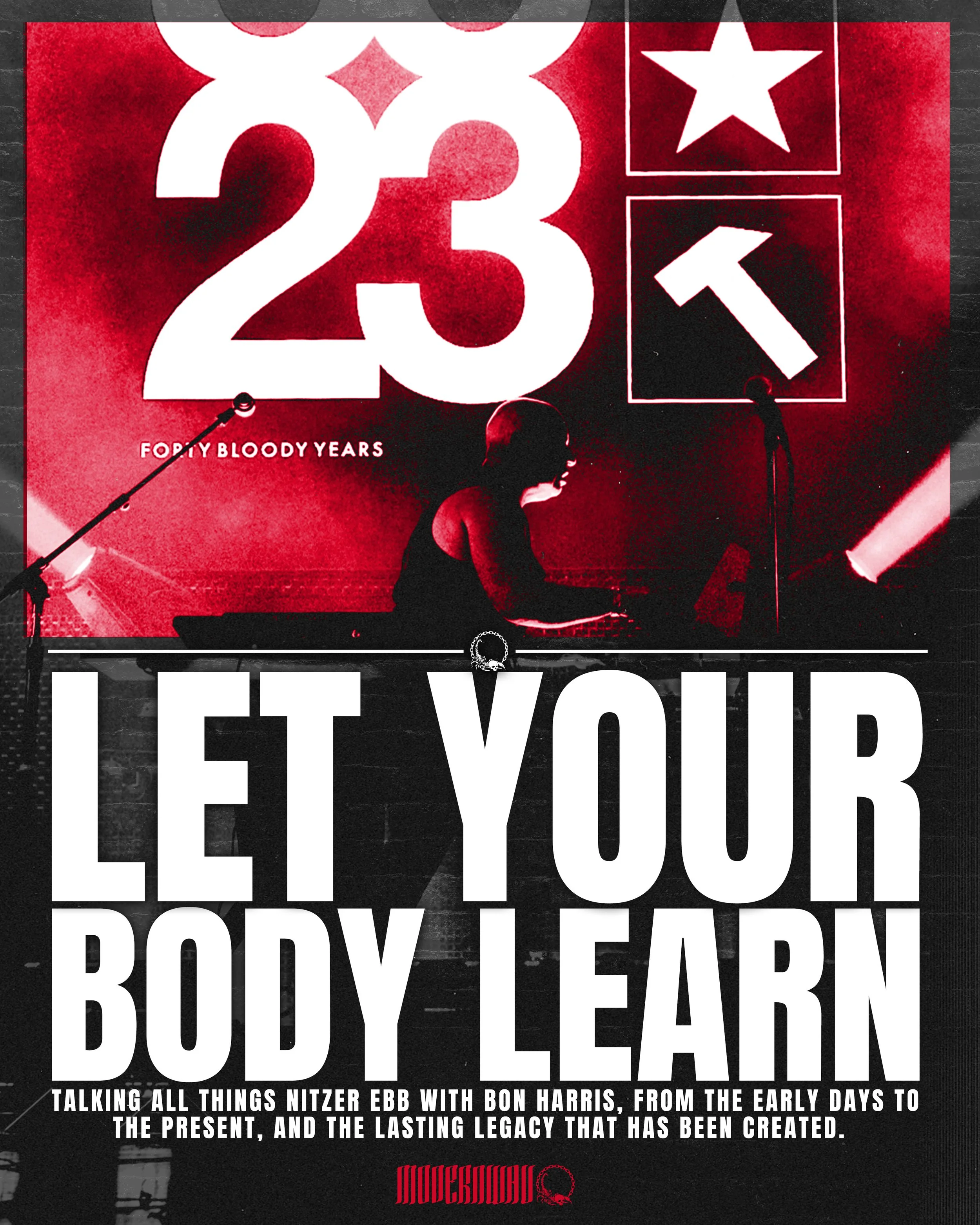
Nitzer Ebb at Modernwav. Photo by Chad Kelco
Few bands have left a mark on electronic music as deep and enduring as Nitzer Ebb. Across decades of records, touring, reinvention, and evolution, their influence has stretched far beyond the scene they emerged from, shaping generations of artists who found something powerful in the band's stripped-down electronics, physical rhythms, and uncompromising approach to songwriting.
I count myself among the artists they influenced. When Matte Blvck began taking shape, I knew immediately that Nitzer Ebb was somewhere in our DNA. Their approach to rhythm, electronics, performance and songwriting had already shaped the way I thought about making music, and that influence has continued to find its way into my own work.
Having now worked with Nitzer Ebb for the third time through Modern Wav, that connection has taken on an entirely different meaning. Our first show together was with Douglas McCarthy, and since then we've had the rare opportunity to witness the band move through an incredibly significant period of change.
I remember being at soundcheck the last time they came through San Diego. We were still loading in, the crews were working around the room, and then the band began to play. Live drums, electronics, and Bon Harris stepping forward on vocals. I didn't really know what to expect. I had never experienced Nitzer Ebb presented quite like that before, and within moments I was floored.
It wasn't simply that it worked. It sounded enormous. The precision and machinery that have always been at the center of Nitzer Ebb were still there, but there was another level of humanity, dynamics, and physicality coming from the live band. It felt technical, powerful, and grandiose while somehow still feeling completely true to what Nitzer Ebb has always been. As an artist myself, it was incredibly inspiring to witness.
That's part of what makes this conversation so meaningful to me. It gave us an opportunity to look back at where Nitzer Ebb came from and how they discovered their sound, but also to talk openly about the years that followed, the evolution of the live band, Douglas, the decision to continue, and the new music that represents the next chapter of their story.
As Bon explains in this interview, there is a desire within the band to see that story through with dignity while continuing to give people the opportunity to experience these songs. I can only speak for myself, but I certainly still want to hear them. I still want to see this band onstage. And after watching Nitzer Ebb evolve while remaining unmistakably themselves, I'm grateful that Modern Wav has been able to play even a small part in that continuing story.
Here is our conversation with Bon Harris of Nitzer Ebb.
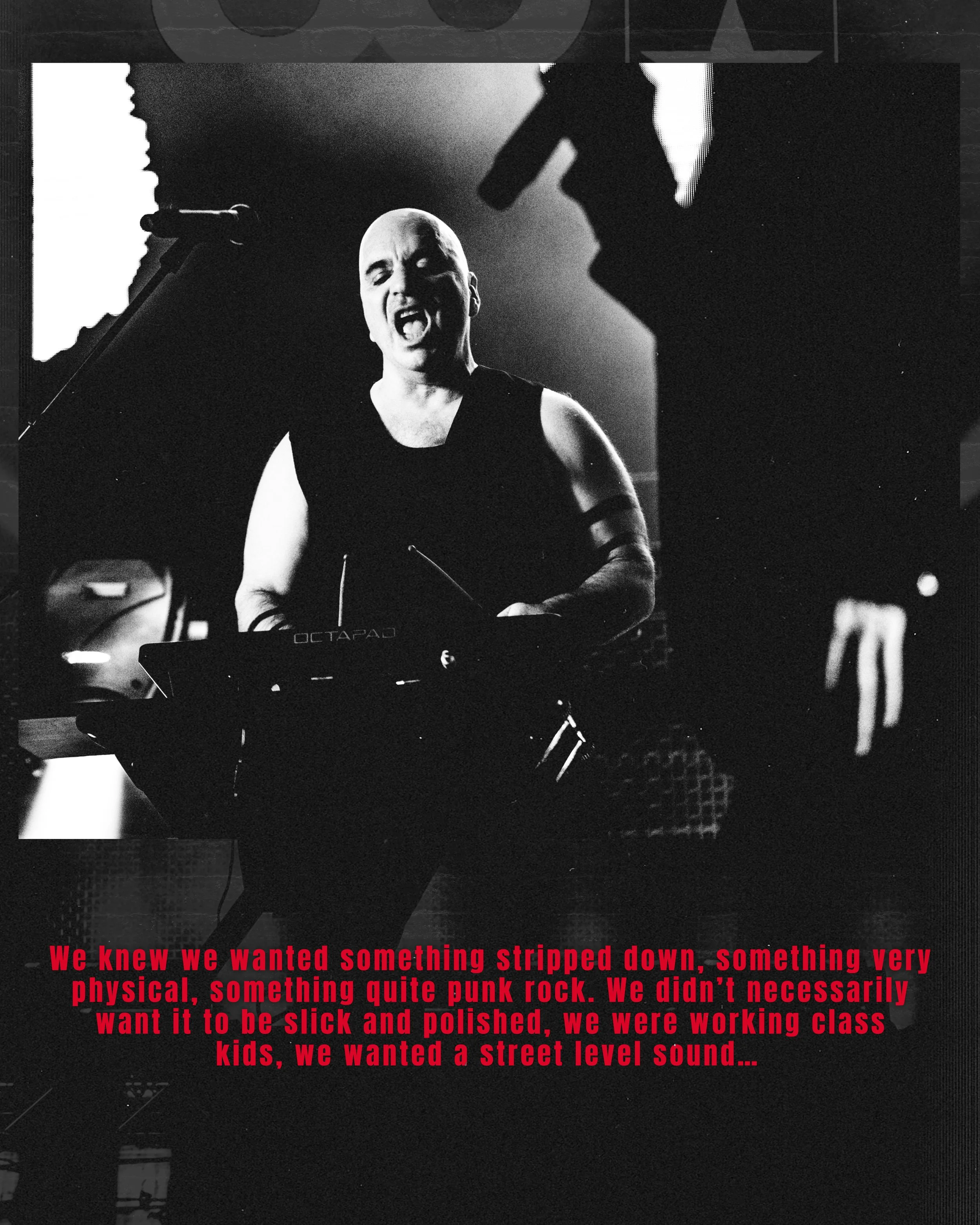
Nitzer Ebb at Modernwav. Photo by Chad Kelco
Nitzer Ebb has lived several different lives at this point, from the earliest days in Essex to becoming one of the defining acts of electronic body music, through years of touring, hiatuses, reunions, and now this current chapter. When you look all the way back to the beginning, how did the band actually come together, and at what point did you realize that what you were creating had become something much bigger than the scene immediately around you?
Nitzer Ebb has been through a lot of iterations and changes from our early days in Essex. And I think the first time we realized that it may be becoming something bigger than a local scene was when Mute first started to get interested.
We were big fans of Mute from the beginning. Fad Gadget, The Normal, Depeche Mode, you know, all those early releases were coming out when we were first getting into electronic music, and in a big way.
And so in a lot of ways it was kind of a dream come true, a real ambition to sign to Mute, and it definitely was a sign that perhaps things were moving beyond a local scene and onto a wider stage in general.
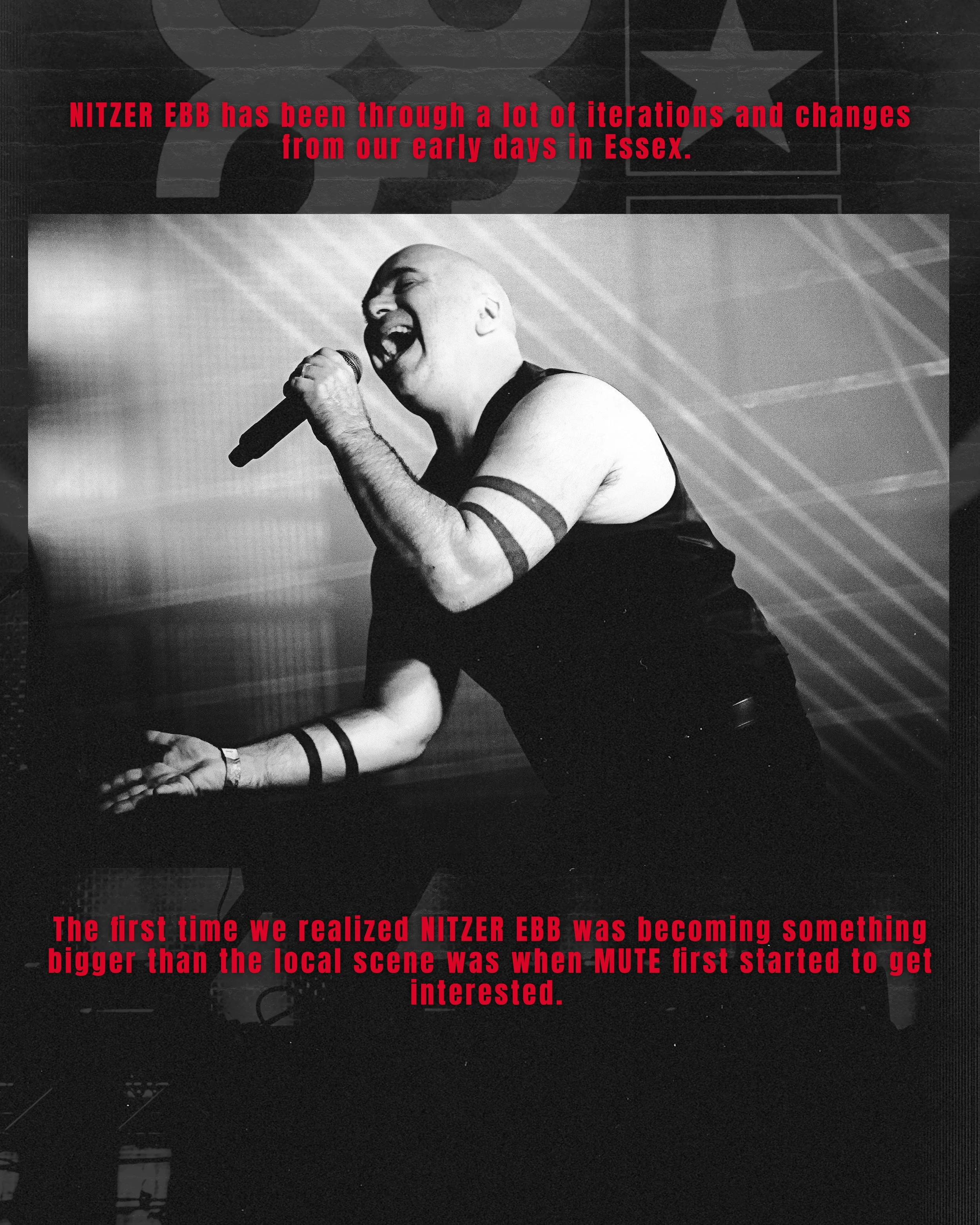
Nitzer Ebb at Modernwav. Photo by Becky DiGiglio
The early Nitzer Ebb records have such an unmistakable identity: incredibly stripped down, physical, confrontational, and rhythmic. What did the writing process look like when you were first developing that language? Was there a moment when you realized, “this is our sound,” or was it something that emerged naturally through experimentation and limitations?
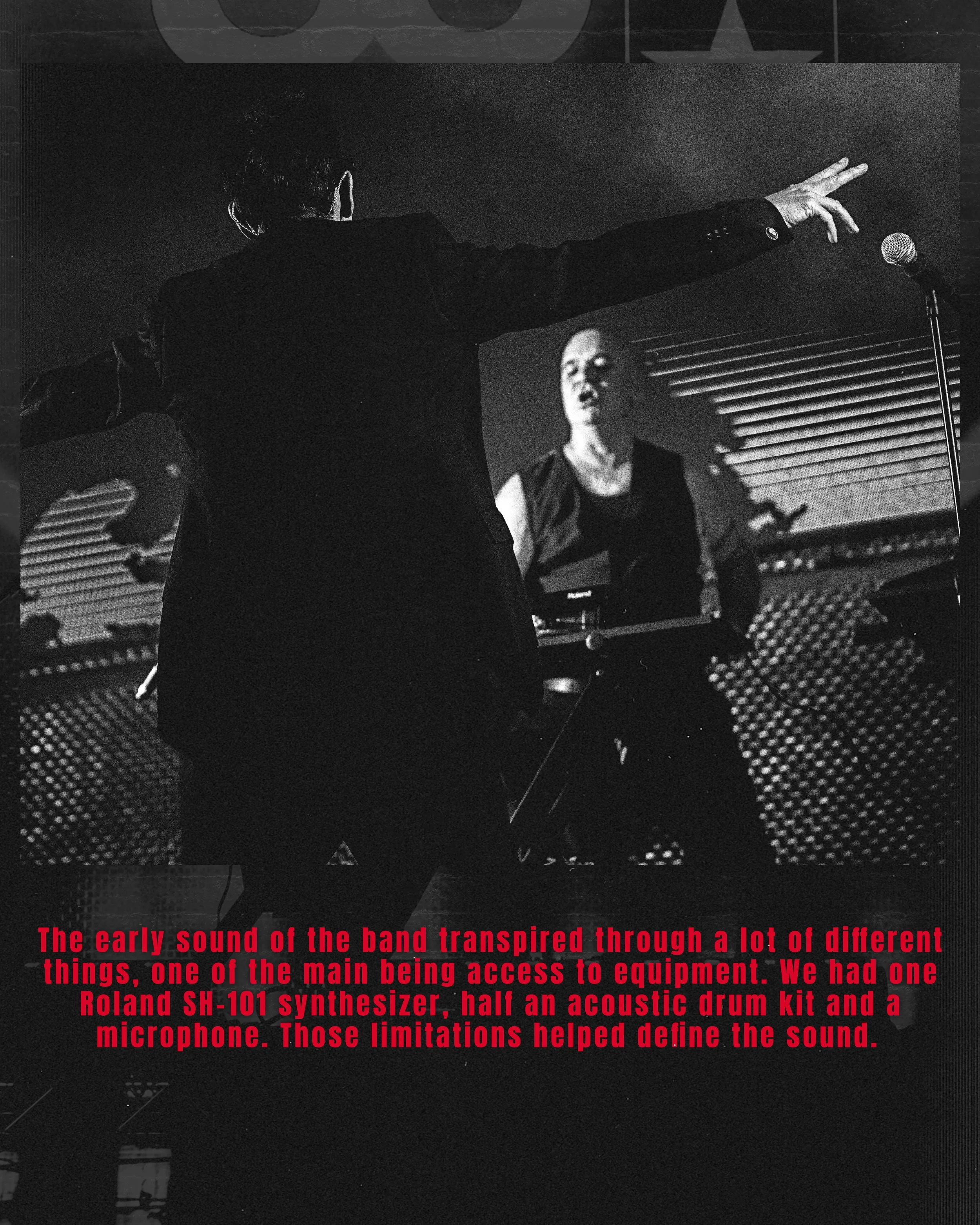
The early sound of the band kind of transpired through a lot of different things. One of the main ones probably was access to the equipment that we had. You know, we had one SH-101 synthesizer, kind of half an acoustic drum kit, and a microphone. You know, and those limitations helped define the sound.
But early on, when we first noticed electronic music, it was through tracks like Donna Summer's I Feel Love, Sylvester's tracks, you know, the early sort of electronic disco stuff, and then obviously as post-punk came in, there were a lot more references available.
But we knew we wanted something stripped down, something very physical, something quite punk rock. We didn't necessarily want it to be slick and polished. We were working-class kids, and, you know, we wanted a kind of street-level sound, which was convenient because that's all we could afford, really.
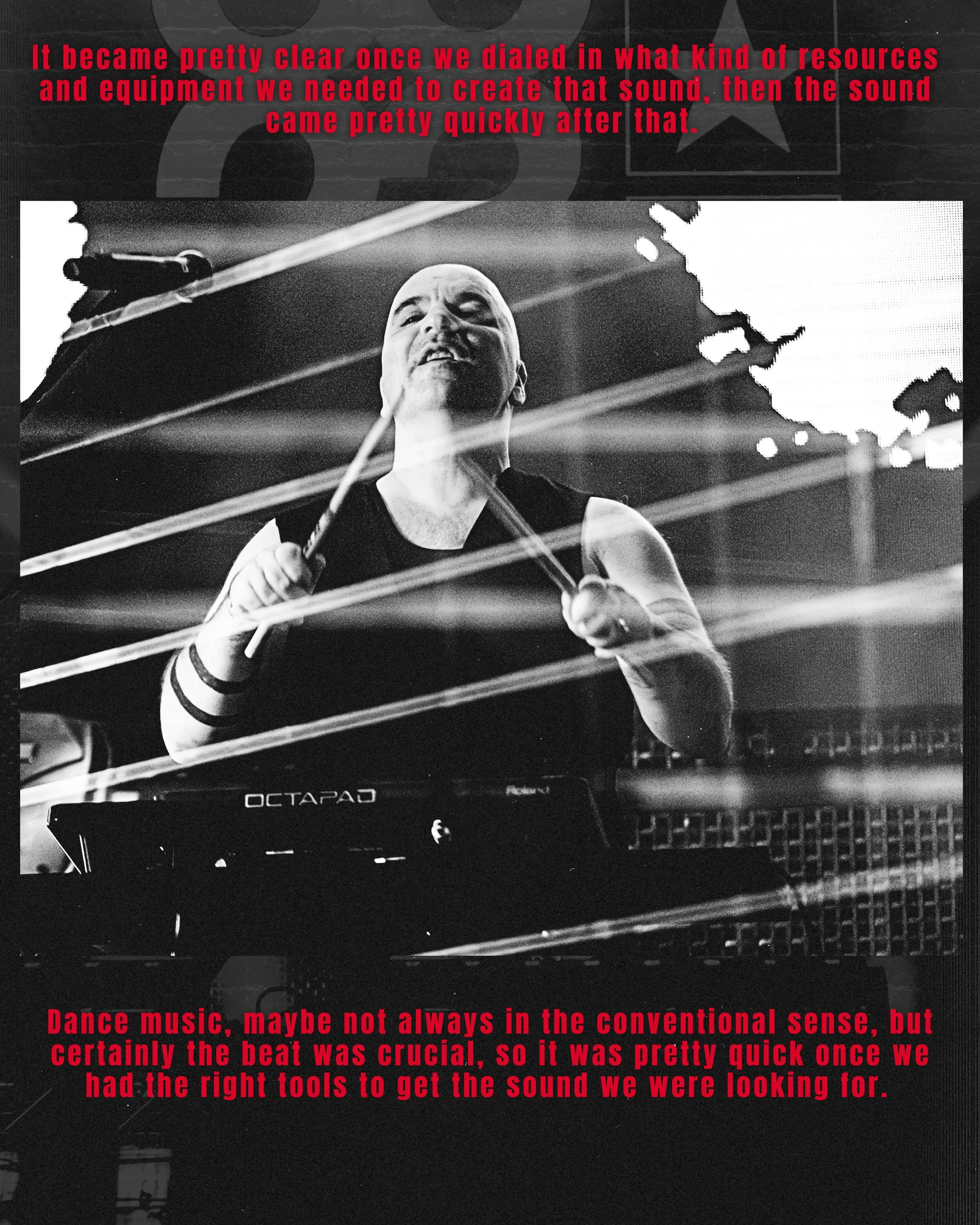
So yeah, we just gathered the materials that we thought would get us there, and yeah, it became pretty clear once we dialed in what kind of resources and equipment we needed to create that sound. Then the sound came pretty quickly after that.
But we had quite a clear idea of what we wanted it to be, you know, those early Donna Summer and Sylvester records were literally just drums, a bassline, and a voice. And we knew we wanted to be in that area, basically, and lots of percussion, you know, dance music, you know, stuff, maybe not always in the conventional sense, but certainly the beat was crucial.
So it was pretty quick, you know, once we had the right tools to get the sound that we were looking for.
Nitzer Ebb at Modernwav. Photo by Becky DiGiglio
One of the things that struck us the last time we saw Nitzer Ebb was how powerful the expanded live presentation felt, particularly having live drums alongside the electronics. The lineup has continued to evolve, and now you’re also carrying much more of the vocal role yourself. How have you approached rebuilding and dialing in the live sound while still protecting the identity and physicality that people associate with Nitzer Ebb?
The recent iteration of the live show, in some ways, marks a return to the early days of the band. You know, as I mentioned, we had a very simple setup, and our early drums were acoustic drums. We always had this mixture of live acoustic material and electronics.
So later on in our touring, it was a little easier to get sort of a cleaner, more punchy sound using electronic drums. And I think in combination with our resources and perhaps the live technology at the time, that seemed like a better way to go for us. Until, you know, later projects, Big Hit in particular, and Industrial Complex, where Jason Payne came along and joined in. You know, that sort of marked a return to our roots.
And live drums always bring such a dynamic and a humanity to the proceedings. And so in a lot of ways for us, that felt like a return to our roots.
We still experimented, you know, in 2018 and 2019, we went for a more electronic approach. Some of that these days for musicians is purely practical. It's quite expensive to take a drum kit out on the road, quite time-consuming to mic it up, and in some cases for some bands, you know, it requires an extra person on the road.
For this latest iteration of the band, we decided that all of those factors were worth taking on because we wanted to come kind of full circle back to the pure essence of the band, and in some ways, you know, just to have that dynamic.
I think the way things are now, especially with AI and slickly produced electronic stuff, we felt like the more humanity and the more organicness that you could have represented on stage, I think a section of the audience is yearning for that. We certainly are as artists.
I feel like there is a perfect blend between the sort of precision of the electronics and the humanity of the vocals and the drums.
And in terms of my step up to taking vocals, or stepping forwards, probably more accurately, that was purely circumstantial. You know, everybody knows the situation that the band's been through, and in a lot of ways we were fortunate that we had another person within the band that was able to do it.
So, you know, I'd been working on different projects, solo projects myself, where I was singing more, and it was synchronicity really, in some ways, in terms of that circumstance coming about. I mean, a dark circumstance, and a circumstance that none of us wished for, you know, certainly not me.
But it just so happened that we were able to come up with a solution to kind of help us through it. And there's not too many bands that can do that, that have got someone within the band, an original member, that can take over those things or hold them down or stand in place to do them.
So yeah, really that combination of live drums, live vocals, and sort of electronic precision is what's always been at the center of the band. And yeah, it just felt really natural and really right to sort of come full circle and return to that.
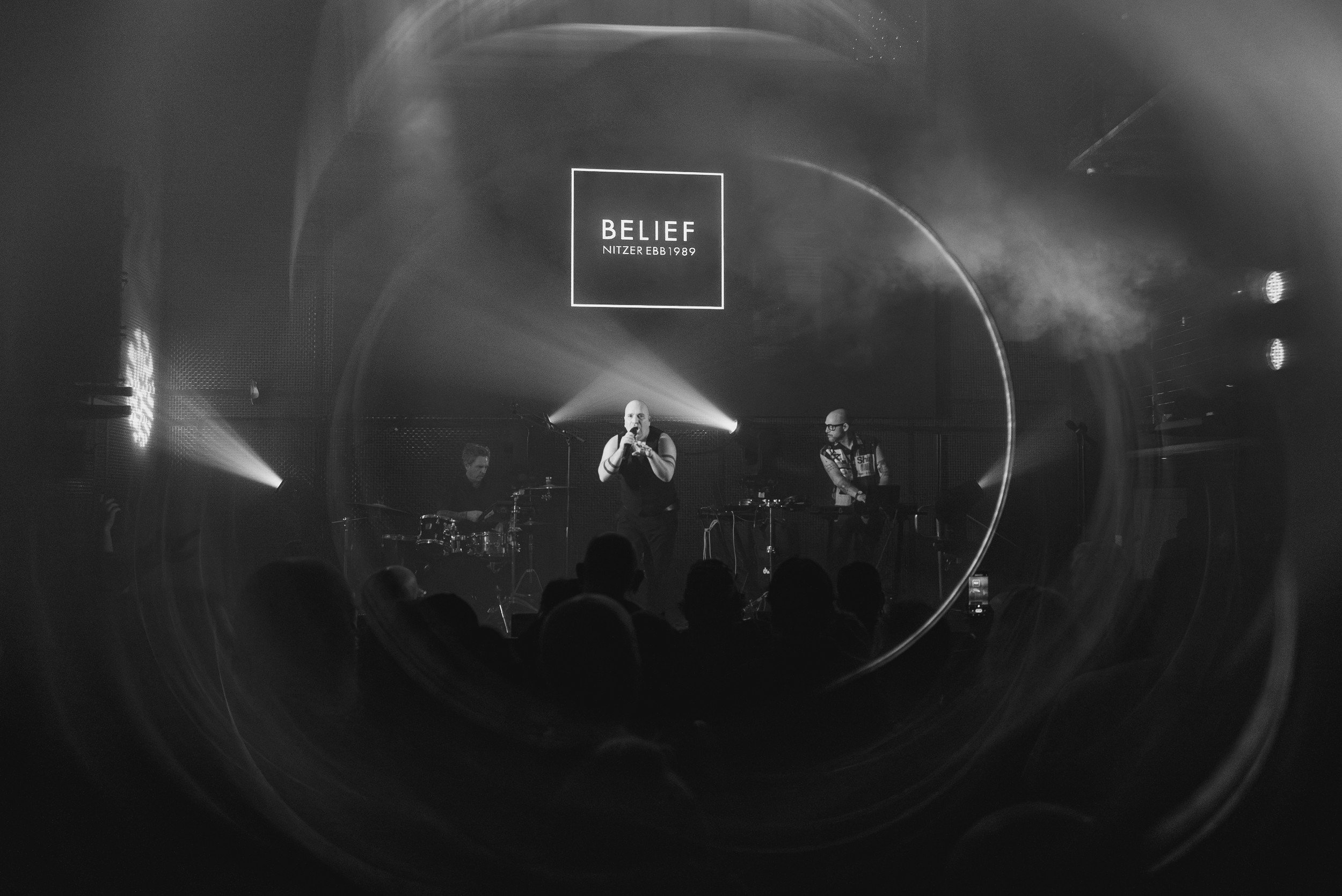
Nitzer Ebb 2025 at Modern Wav, Photography by Clint Pinkston
Nitzer Ebb at Modernwav. Photo by Chad Kelco
Continuing Nitzer Ebb after losing Douglas must have involved decisions that went far beyond simply deciding whether or not to tour. Without asking you to revisit anything you would rather keep private, what was the process of deciding that Nitzer Ebb should continue, and what does carrying this music forward mean to you now?
Much of the process of deciding to continue to do shows in Douglas's absence was really beyond our control. You know, Doug's health condition began to manifest in the midst of a lot of touring, and it was a very fluctuating circumstance.
So every time we had the decision to take to book more shows, we had to weigh up. It was not clear which way things were going to go, so we had to book the shows in order to keep going as a band, and then just deal with wherever we were at when it was time to play those shows.
And unfortunately, you know, Doug's condition meant that sometimes he wasn't able to perform, and I was required to step forward to hold those shows down. But a lot of the time there really wasn't time to think about it. We were already committed to a lot of shows, and the way booking goes these days, you have to commit a long time in advance.
So of course we discussed it every time we were about to commit to new things, and made those commitments, and just dealt with the situation as best we could whenever we got there.
And most of these shows that we've done in 2026 were booked when Douglas was still with us, and when there was still a chance that he may be able to perform them. So we had to commit to them, and cancellations are never good for anybody. They're not, you know, anybody involved with the experience. That's not a good thing.
And in general, we would discuss what our best option was, and it always was to continue and to fulfill our obligations, and give people a show rather than no show, and that's what we've stuck to.
And in some ways, you know, the band is older now, and a lot of bands, a lot of our peers, have already retired or announced they're retiring. And through all that turbulence, when Douglas was suffering, you know, there was a real chance that the band would just come to a grinding halt, which would have been a terrible shame for a band with such a long career.
So all of us involved were kind of determined to try and see it through, so that whenever we did get to a point that we decided to call it a day, that it could be done in a kind of managed and dignified manner that really befits the career that we've had.
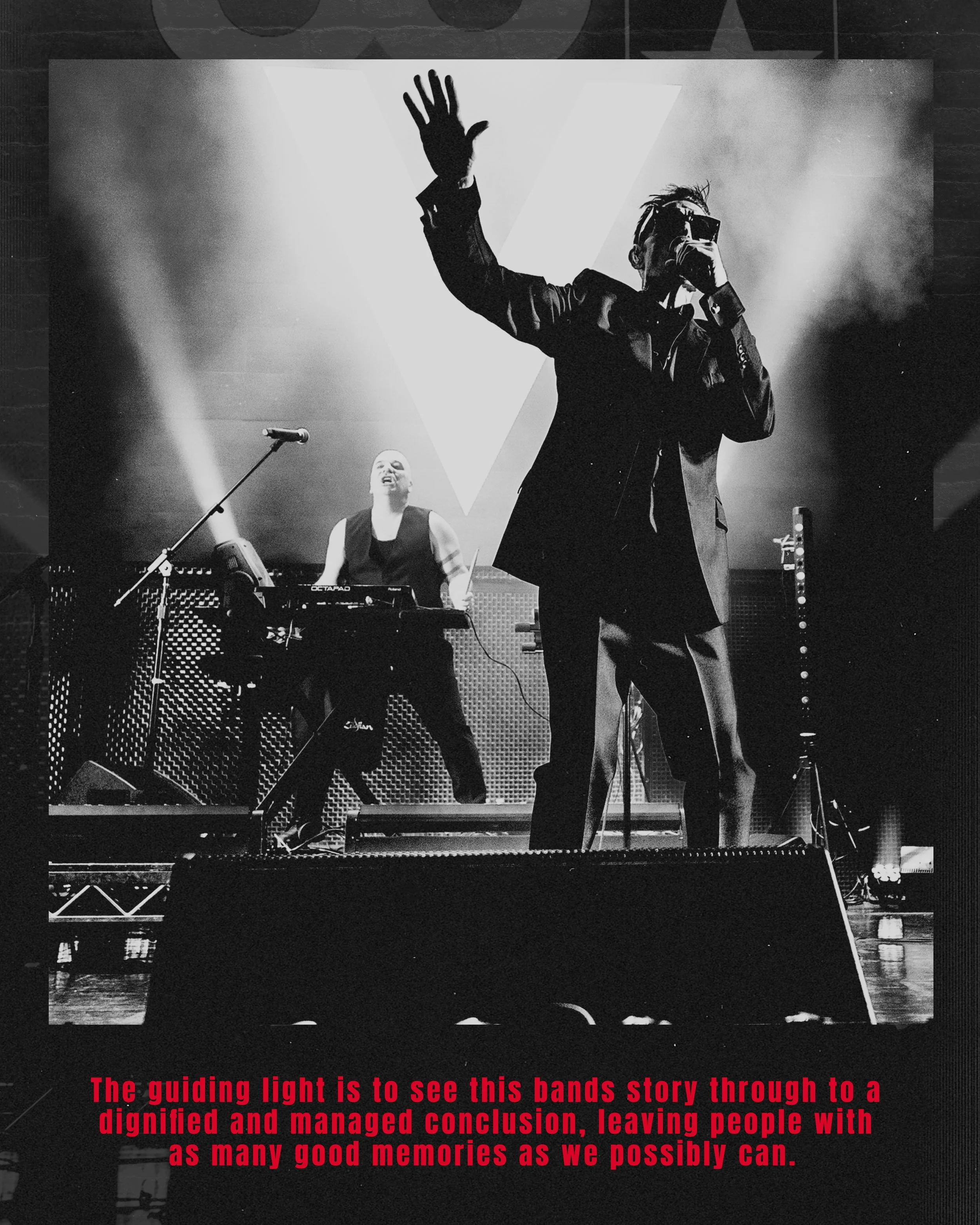
And I think that's still the guiding light for all of us. You know, it's the guiding light while Doug was still with us, and it's still the guiding light, is to see this band's story through to a dignified and managed conclusion, and try and leave people with as many good memories as we possibly can.
We realise that there are some people that have difficulty with the idea that it's carrying on, but I think all of us involved, the shows that we do do, there's a lot of people that are very grateful and very happy that they get to hear the music one more time.
We would all prefer to have heard it with Douglas with us, but sadly that wasn't the case. So what the case is now is that we're doing the best we can to just keep the band's legacy alive, keep it intact, and give people some good memories.
That's really the size of it.
Nitzer Ebb at Modernwav Photo by Chad Kelco
You’ve recently spoken about a substantial collection of new Nitzer Ebb material, including recordings made with Douglas as well as music representing where the band is headed now. What can you tell us about that record, and how do you approach making something that acknowledges the history of Nitzer Ebb without being constrained by it?
Doug and I had been writing on some collaborative projects around the end of 2021, and maybe it was subconsciously training ourselves, getting ready to write new Nitzer Ebb material because, you know, I think we wanted to write again, but do it in an environment where there wasn't any expectation or pressure on it necessarily.
And we enjoyed that process so much and worked so well together that we decided, okay, let's take a crack at writing some new Nitzer Ebb material.
And with a band like Nitzer Ebb, you know, there's a large catalogue, quite a legacy, and it spans a lot of musical ground stylistically, so it's very easy to freeze up in that situation and be, you know, caught up in maybe option anxiety or expectation and everything else.
So to combat that, I decided to go back to the very first synthesizer that we used, a facsimile of the SH-101, the Roland SH-101, and decided to write the initial tracks on that because it's such a simple process and it's such a characteristic sound, and it is a sound that's very characteristic of our early records.
So I started there, and because it's such familiar territory and it's where the early material came from, it yielded great results very quickly, and that kind of gave us the confidence then to once we had a few of those songs under our belt and it was sounding good, it gave us a foundation to then start expanding and looking around at more modern techniques or modern things that we'd taken on and consider how we were going to incorporate those into something appropriate to the band's sound, because that can also be a difficult thing when you're working on new stuff after a long career and a long break.
You know, you want it to be familiar and identifiable as the band, but you don't want to repeat yourself. You want to experiment, but you don't want to go too far so that it no longer sounds like the band.
So even though it's a fairly simple prospect, there are a lot of things to juggle and, you know, as with many things, your psychology can get in the way of that.
So really, by choosing the sort of simplistic approach, we created baby steps for ourselves, and that gave us a solid foundation and the confidence to then start experimenting with other things.
And very soon we were off at the races and, you know, coming up with new ideas and new sounds that still sounded very much like the band, and yeah, quite quickly over time built up a solid body of work.
And it was an interesting time, obviously, because of Doug's journey. So the time we were working on that new material, obviously he was going through a lot of changes.
So in a lot of ways it is quite unique in the way that it captured the journey of an artist in real time through some quite dark times.
And the album's quite unique in that way, I think, as a personal record of an artist living and working through a situation and charting their progress through that.
So yeah, it's quite a unique document, really, in a lot of ways.
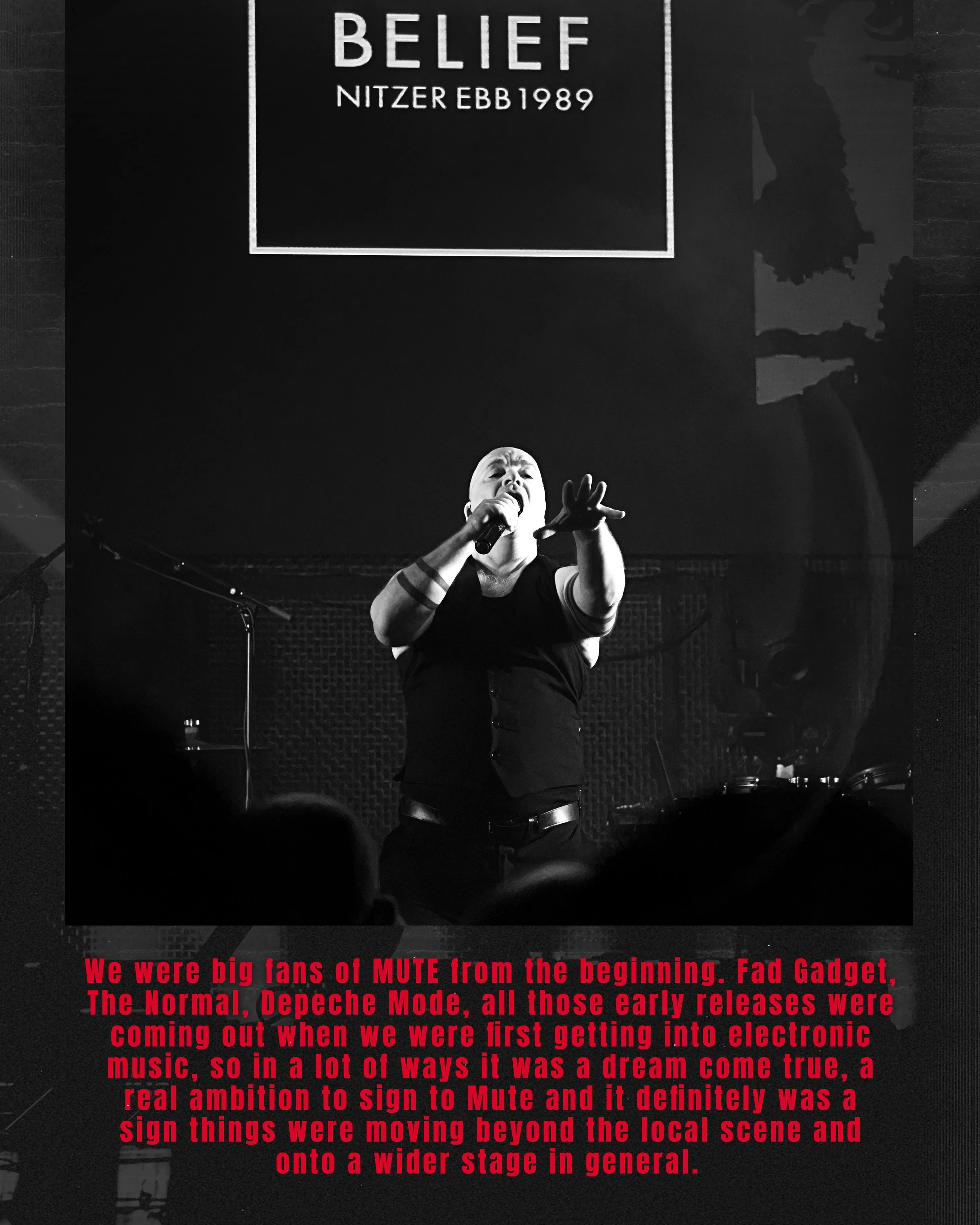
Nitzer Ebb at Modernwav. Photo by Clint Pinkston
This will mark your third time with Modern Wav in San Diego. We’ve had the privilege of watching the relationship between the band and the audience here grow with each visit. What do you remember about those previous San Diego shows, and after all these decades of traveling and performing around the world, what makes a city, a room, or an audience become somewhere you actually look forward to returning to?
Yeah, this will be the third time that we've returned to San Diego with this collaboration, and there are a lot of things that make a city stand out.
I mean, the venue in San Diego that we played at is excellent. It's very well laid out. The sound system is excellent. The audience is always really lively and really enthusiastic, and, you know, everything's well organized and professional, and it makes it very easy to give your best in that situation.
And I think when it's a sort of clean, enjoyable environment for the audience, it makes it easy for them to bring their best energy as well.
It's a comfortable place to play. It sounds great. The sight lines are good. It's always super well organized, and, yeah, it's just a real pleasure to work under those conditions because you don't always get that, you know, on our tours.
And yeah, I think that's why those shows are always so enjoyable to do and so successful.
And, yeah, we're really looking forward to coming down and seeing everyone soon. So we'll see you there.
For a band with this much history, legacy can easily become something static. What stood out to me in speaking with Bon is that Nitzer Ebb still feels very much alive — not because the band is trying to recreate the past, but because they continue to engage with it, evolve through it, and carry it forward in a way that still feels honest.
There is a tremendous amount of history in these songs, but there is also a clear sense that the story is still being written. Hearing Bon speak about the band's early years, the evolution of its sound, the years of touring, the new material, and the future made that especially apparent.
For me, that is what makes this next San Diego show feel special. It is another opportunity to experience a band with an extraordinary catalog and legacy while they continue moving through a new chapter of their history.
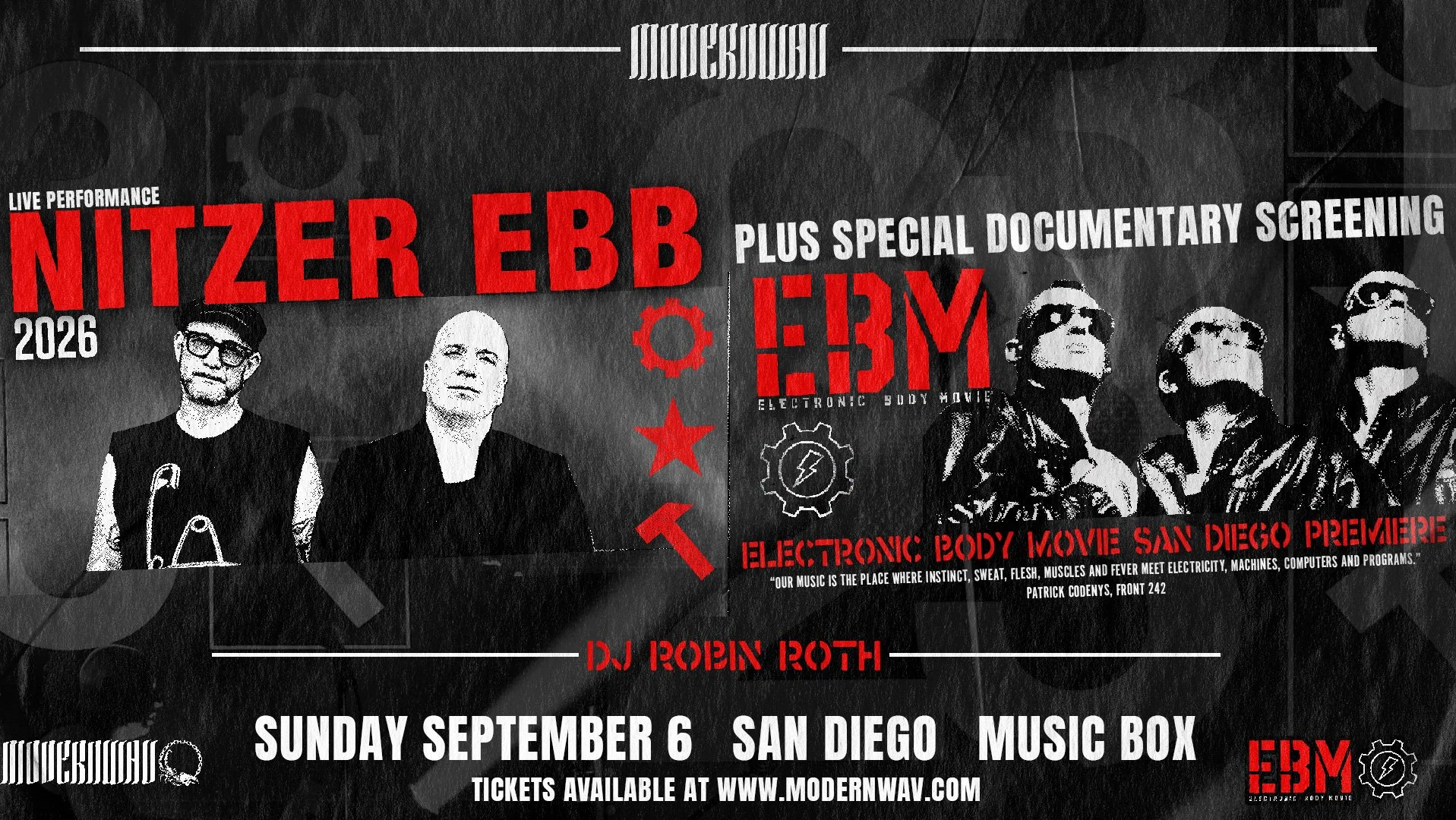
We’re grateful to Bon for taking the time to speak with us, and we look forward to welcoming Nitzer Ebb back to San Diego with Modern Wav on September 6 at Music Box, joined by Lead Into Gold, DJ Robyn Roth, and a special screening of Electronic Body Movie.
Explore More from Modern Wav
Modern Wav is a San Diego-based platform covering goth, darkwave, industrial, EBM, post-punk and underground electronic music through live events, artist interviews, editorial features and nightlife coverage throughout Southern California.
Explore more:
Follow Modern Wav for upcoming events, interviews, live performances and underground music coverage.
Written by Alex Gonzales
Alex Gonzales is the co-founder of Modern Wav and a San Diego-based musician, producer and event curator. Through Modern Wav, he works with artists across industrial, darkwave, EBM, post-punk, and underground electronic music, while producing live events, interviews, and editorial coverage throughout Southern California.
Related Topics
Nitzer Ebb • Industrial • EBM • Darkwave • Post-Punk • Underground Music • San Diego